Showing posts with label homeless. Show all posts

Monday, April 29, 2013

Waiting for the Call


One hour away from Springs Rescue Mission at a Denver hospital today, a precious one-year-old is on life support. A medical team there is waiting for the call from one of our neighbors – the grandfather of the child – to unhook the machines that are keeping her body alive.

Goodbyes have already been said. Preemptive tears have already been spilled. The pros and cons of one more visit have been weighed. Dave, the grandfather, could say volumes to his granddaughter with one more encounter. But how long do you keep going with a series of “just one more visit”? Dave has made a remarkable decision for someone who seems to have so little to hold onto: to let go of the baby for whom he’d someday hoped to build a safe and sound home.

It was a dream of sorts. Dave knew that the odds were stacked against them. Yet this year he took tangible steps forward to overcome those odds – receiving medical care that indicated he planned on sticking around for awhile, for instance. Maybe long enough to raise grandchildren. He took a serious look at housing and childcare options. He began thinking about jobs that would welcome his work experience.

Dave was expecting challenges in those areas. What he didn’t expect was a sudden and brutal traffic mishap that took his daughter a few weeks ago, and today will take his granddaughter. Homeless or housed, rich or poor, you never expect such things. Sometimes life itself levels the playing field in ways you never wanted.

Dave has not felt in control of his life for years now. The irony of doctors and nurses waiting for his phone call is not lost on him.Yet there is something sacred about Dave’s day today. His friends at the Mission and on the streets know it. He will manage a painful and loving call, and a choice few around him will hold him close in their hearts.

They will pray Dave makes a fresh decision to walk toward healing, and that he shows up at our door again tomorrow.


Wednesday, January 30, 2013

Ain't Worth Spit


It didn’t take many discussions with the homeless neighbors we serve at Springs Rescue Mission for me to understand one secret they share with all of us: when it’s all said and done, our behavior—yours, mine, theirs—depends way more on our view of ourselves than we might think.

The biggest challenge for many of them, just as it is for each of us, is to own the truth that God cares for each of us, even with our stinking moods and damaged behavior on the table in the light. One of the most difficult truths of the universe for many of us is that God still loves us with all our stuff in plain sight. Mother Teresa summed it up: "The hunger for love is much more difficult to remove than the hunger for bread."

A few colleagues and I were having an informal conversation with Martin, who camps a few miles from the Mission on land outside Colorado Springs. Martin lost contact with some of his family after spending too many years under the influence. He has lost others he loves to violence and disease. When someone approaches Martin, he pulls into himself relationally and physically. He is conditioned, by years at the business end of condescending looks and cruel comments and treatment as an untouchable, to cringe until the person has passed.

Martin explains, “They have a place to go. We don’t. They don’t know what it’s like for us. No way.

“A lot of people treat us like we ain’t worth spit, anyway.”

Martin is tormented. But he also knows his hunger for acceptance and encouragement is being met somehow by showing up at the Mission for a cup of coffee six days a week.

In Jesus’ day, any lasting physical affliction was commonly assumed to be caused by a great sin. It was fairly common for people with such afflictions to be spat upon by upright citizens even as the afflicted were begging for alms. In fact, one Sabbath day a blind man heard someone making the sounds of gathering spittle.  He braced himself in case that someone loosed it in his direction.

But this time, the spit didn’t hit him. It landed in the dust at his feet. He heard some rustling and a pair of hands rubbing together and then felt mud on his eyes. It was an experience with someone spitting he’d never had before.  

Then the blind guy heard a voice telling him to go wash off the mud in a pool of water. It was treatment he’d never heard of. The pool was about 600 yards away. He’d break some religious rules by journeying that far, but so had Jesus by making the mud. So the blind man went, washed, and could see.

He’d never think about the sound of someone spitting in the same way again. He wouldn’t feel the need to recoil in self-loathing when someone approached him.   

If you want to look at them this way, you can see every person who is a prime candidate for being a social outcast (e.g., homeless, at-risk, bullied at school, ridiculed at work) as being someone in whom the very work of God is waiting to be shown. We need to offer them life experience that demonstrates, rather than denies, their intrinsic value. 

Nothing will change the way you view the people living on our streets like taking some time to meet them.

They’re worth spit to Jesus, after all.


Wednesday, October 10, 2012

Perfect Storms, Tribes and Social Miracles


The common definition of a “perfect storm” began as “a phenomenon where conditions are just right to produce an event of catastrophic proportion.” I’ve also heard “perfect storm” used frequently and, I think, appropriately in describing the lives of so many we serve at the Mission. 

Rarely can we point to one single circumstance that drives a family or an individual into profound need or homelessness. It’s more a matter of conditions piling on top of each other in a way that produces catastrophe in someone’s life.

For example, when Warren lost his wife to cancer some years ago, he turned inward and medicated his grief with alcohol. He ended up alienating his married children and grandchildren. He began showing up at work hung over and depressed, which led to him losing that job. Unable to find another job in a shrinking economy while he was on unemployment, he ended up homeless, alone, hungry and addicted.  Grief, alcoholism, broken relationships, an economy on the fritz and fading chances for employment. Smells like a storm, doesn’t it?

Jerry’s cardiologist is convinced that the stress of being laid off led directly to Jerry’s cardiac collapse a few months later. Jerry kept looking for work while he was recovering. He went into interviews looking well-dressed, but really haggard. Meanwhile his nest egg shrunk and then disappeared. His deteriorated health fed his deteriorating opportunity to work which further deteriorated his economic stability-- or should that be in another order? Maybe it’s all of the above, together, firing at random.
So what do you do when your neighbor is caught in storms like those? Convene the next meeting of experts and make the homeless and hungry the main topic? Write a politician and tell her to take care of the problem? Hope some rich family foundation or Donald Trump-type coughs up a huge check?

What if you could be part of a social miracle? 

In his book Lost Icons (T&T Clark 2000), Rowan Williams (yep, that one -- the Archbishop of Canterbury) comments on what historian John Bossy calls “the social miracle” of the medieval community and church -- charity resulting from “the extraordinary process by which sectional loyalties were from time to time interrupted and overcome by a sense of integration, of belonging to an entire social body extending far beyond one’s choice or one’s affiliations of interest and ‘natural’ loyalty” (Williams, p.54).  In other words, people made the choice to move beyond the tribalism of the Dark Ages into a greater community to benefit those in need. Bossy counts that as nothing short of a miracle. 

He’s probably right. Think about the tribes, each with their own biases, mores and folkways, in our modern culture. Tribes spring up over economic status. Tribes thrive on divisive politics. Tribes nurture differences of social position. Tribes watch with fear should someone invade a comfort zone within their territory. Asking tribes to move beyond their perceived boundaries of relation is tantamount to social heresy. If one’s boundaries don’t include those who have slipped into a different tribe of people struggling with alcoholism or poverty, it can be difficult to even see the need to offer a hand up to others.

But that hand up is necessary for those neighbors (there’s a community term), many of whom may never share our tastes in candidates, football teams, restaurants or radio stations, who find themselves in perfect storms.  Our neighbors need the extraordinary process that interrupts sectional loyalties and goes way past “natural” loyalties. They need someone, in fact a community of “someones,” to break tribal boundaries and offer a hand up out of the chaos of their perfect storms.

As the old Bruce Cockburn song says, they’re waiting for a miracle: the miracle that happens when our attention is fixed, even for a moment, on the fact that because we share the planet and our days with them, the hungry and homeless are somehow miraculously and wonderfully a part of each of us.

They need responses beyond tribes, elections, and platitudes. Our neighbors need the miracle and true synergy of community response, starting with the life jackets that will help them navigate their perfect storms -- food, clothing, education, options, housing, basic care.

Count this your invitation to be part of a social miracle right where you are.

Thursday, August 9, 2012

Socks, Part Two: Preventing Frostbite and Its Fallout


My good friend Sarah Stacy, who manages the Mission’s Resource Advocate Program (RAP) for the chronically homeless, is genuinely excited about the possibilities of more socks for the neighbors we serve. She states her case far better than I could ever hope to rewrite it:

“The homeless are at great risk of frostbite on their feet for a number of reasons, one of which is damp socks or dirty socks that lose their ‘fluff’ (those air pockets between the fibers that help our feet stay warm) and ability to protect the skin. 

“Frostbite can take up to two years of extensive medical treatment to get taken care of, including inpatient care, managed pain control (which is risky for those with addictive personalities) and visits to wound clinics several times a week during the healing process.  It’s ugly as the tissue that was frozen falls off.  Medical personnel usually have to wait until the toes ‘self-amputate’ to preserve as much of the foot as possible in the healing process. 

“Treatment is painful and VERY EXPENSIVE to the community. Yet adequate footwear, including socks, could prevent the problem. 

“One of the yuckiest parts of caring for the homeless is asking to see their feet in the cold to help prevent these problems.  We have to educate, educate, educate our homeless to take care of their feet, and providing clean warm socks is a major way to help.”

So one more time for those of you in the Pikes Peak Region: You can find sock drop boxes around town in Colorado Springs. There are boxes located at TCF Bank (Powers & Constitution), Remington College, Nazarene Bible College, Gold’s Gym Briargate, The Coffee Exchange, Hollywood Theater (where Timothy Green will debut on August 15) & Community Bible Study.

Your gift of just one pair of socks could save someone a lot of pain, and the community thousands of dollars. (Imagine what a package of six pairs might do…)

Monday, July 9, 2012

A Sudden and Miraculous Grace


(AP Photo/The Colorado Springs Gazette, Susannah Kay; http://www.dailylocal.com/article/20120625/NEWS04/120629708/rememberingpa.us/%27.$a.%27)

Eucatastrophe


Sometimes even when a word is unfamiliar if it sums up a big, far-reaching idea it’s worth using.

“Eucatastrophe” (pronounced YEW-kuh-tas-stroh-fee) is such a word. JRR Tolkien, the author of Lord of the Rings, coined the word to describe what happens in a story when the good that comes out of a great disaster overshadows the disaster itself. In Tolkien’s words, it is “the sudden happy turn in a story which pierces you with joy that brings tears.” 

And what is it like for the characters in, and hearers of, such a disaster? Tolkien himself says the eucatastrophe develops into “a sudden and miraculous grace.” Eucatastrophe never denies the reality of sorrow and failure because it would then deny us the joy of deliverance. It never accepts final defeat but instead gives “joy beyond the walls of the world, poignant as grief,” as a story’s characters -- perhaps with you among them -- come through trials that might easily have shattered them, but in the end didn’t.  

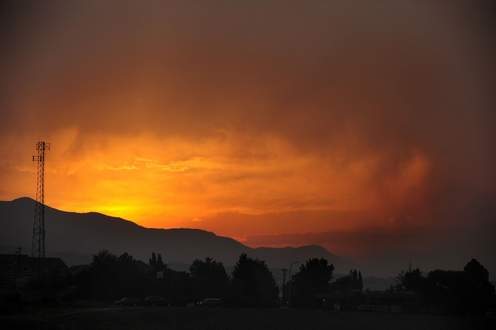
Last weekend one of my lifelong best friends (who, many years ago, actually introduced me to both Tolkien and “eucatastrophe”) and I joined family and friends for dinner and dessert in the shadow of the Pikes Peak range. Just a few days before the Waldo Canyon fire had been, by any reckoning, a great disaster.  But not long after, a sudden and miraculous grace -- the combined efforts of firefighters, a break in conditions, the prayers of strangers, the generosity of friends, the hand of God -- gave our community a sudden happy turn in the story which pierced us with joy that brings tears.

Today we stand at 98% containment. The fire might well be completely extinguished four or five days before the date originally projected.  (Who knew?)

The Waldo Canyon wildfire trespassing into Pikes Peak Region communities delivered a giant wallop in our collective gut two weeks ago. We sucked in the air around us, befouled as it was with ash and smoke, coughed and straightened up ready for the next round. 

You see, this is a remarkable community in crisis. The phone lines and emails buzzed between agencies, government and non-government alike, in everyone’s joint effort to help. Media dedicated themselves to keeping the community informed, period. Press briefings found a mayor standing shoulder to shoulder with a sheriff next to a fire chief adjacent to a Forest Service official, among others, all in a united front. No finger-pointing there; just colleagues working their way through a disaster.

In the early Christian church, there was a document called the Didache that carried this sage advice when practical challenges disrupted the daily flow of activity: “Do the best you can.” By doing the best we can, we help transform catastrophe into eucatastrophe.

We see that kind of transformation daily at the Mission. I have never yet seen it come without a price, or without the dedication of more people than expected, but I have seen it. It is the kind of transformation we need in continued support of the nearly 350 families whose homes were destroyed by the fire, and hundreds more whose belongings are damaged beyond use. It is the kind of transformation we need to encourage in the hundreds of single-parent families, underemployed families, and others who were homeless before the fire and continue to be so today.

It is the eucatastrophe of ongoing results when tragedies invoke neighbors to help neighbors.  So many people here are good at it already. Others have taken the opportunity in the last two weeks to put it into greater practice.

And I have this feeling that few of us will rest until the tears we see in those around us, too, are pierced with joy.


Tuesday, April 10, 2012

So What Are the Odds?


It was waiting for me as I walked to my office door at the Mission this morning: a lottery ticket. Right there on the concrete landing; all bright and shiny.

Don’t get too excited. It was just a used scratch ticket. Someone had played the odds and lost, pure and simple.

Yet I couldn’t help but think about the odds in the everyday lives of the people we serve. What are the odds that someone becomes homeless, anyway? According to a trusted report on homelessness in America, over the course of a year the estimated odds of experiencing homelessness are presently about

  • · 1 in 194 for the general population,
  • · 1 in 29 for people with incomes at or below the poverty level,
  • · 1 in 10 for veterans living in poverty,
  • · 1 in 12 for people living with friends or relatives due to economic need,
  • · 1 in 13 for a person discharged from incarceration, and
  • · 1 in 11 for youth aged out of foster care.[i]

I don’t pretend to know how those figures strike you. They startle me. Look at them: about a 10% chance of being homeless this year if you’re freshly out of jail or foster care, or if you’re living with friends or relatives because of money, or if you’re a veteran living at or below the poverty line. You have a tad more than a 3% chance of being homeless if your income is at or below the poverty level.

(And just so you know, your odds are significantly better for becoming homeless from the general population [1 in 194] than for winning just $21 from playing a Colorado state scratch ticket [1 in 300].[ii] Just sayin’.)

Someone had thrown the ticket down in frustration or resignation or anger (maybe) for the loss of hope they’d once held in the ticket. I just hoped that it wasn’t someone who was homeless or at-risk. That feeling of loss, that stinging hurt of once having possibilities and now having empty hands, is all too common for our neighbors who come here for help. A losing scratch ticket likely would add insult to injury. But they’d already feel that the odds were stacked against them, wouldn’t they?

That’s why the roles we play as friends of the homeless matter. You matter because whether you encounter a homeless person only on occasion, or you meet new faces from the homeless in your community every day, you become a vendor of hope. Few feel the impact of hope (or the lack thereof) as keenly as those who consistently face homelessness.

Our task is to help them beat the odds against them.

Chances are we have better odds of doing that than in winning the lottery, at least.


[i] The Homelessness Research Institute. The State of Homelessness in America 2012, National Alliance to End Homelessness, January 2012, 38-39.