 | |
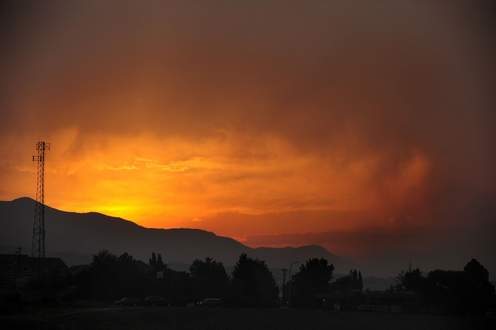
| (AP Photo/The Colorado Springs Gazette, Susannah Kay; http://www.dailylocal.com/article/20120625/NEWS04/120629708/rememberingpa.us/%27.$a.%27) |
Eucatastrophe
Sometimes even when a word is unfamiliar if it sums up a
big, far-reaching idea it’s worth using.
“Eucatastrophe”
(pronounced YEW-kuh-tas-stroh-fee) is such a word. JRR Tolkien, the author of Lord of the Rings, coined the word to describe what happens in a story when the good
that comes out of a great disaster overshadows the disaster itself. In
Tolkien’s words, it is “the sudden happy turn in a story which pierces you with
joy that brings tears.”
And what is it like for the characters in, and hearers of,
such a disaster? Tolkien himself says the eucatastrophe develops into “a sudden
and miraculous grace.” Eucatastrophe never denies the reality of sorrow and
failure because it would then deny us the joy of deliverance. It never accepts
final defeat but instead gives “joy beyond the walls of the world, poignant as
grief,” as a story’s characters -- perhaps with you among them -- come through
trials that might easily have shattered them, but in the end didn’t.
Last weekend one of my lifelong best friends (who, many
years ago, actually introduced me to both Tolkien and “eucatastrophe”) and I
joined family and friends for dinner and dessert in the shadow of the Pikes
Peak range. Just a few days before the Waldo Canyon fire had been, by any
reckoning, a great disaster. But not
long after, a sudden and miraculous grace -- the combined efforts of
firefighters, a break in conditions, the prayers of strangers, the generosity
of friends, the hand of God -- gave our community a sudden happy turn in the
story which pierced us with joy that brings tears.
Today we stand at 98% containment. The fire might well be
completely extinguished four or five days before the date originally projected.
(Who knew?)
The Waldo Canyon wildfire trespassing into Pikes Peak Region
communities delivered a giant wallop in our collective gut two weeks ago. We
sucked in the air around us, befouled as it was with ash and smoke, coughed and
straightened up ready for the next round.
You see, this is a remarkable community in crisis. The phone
lines and emails buzzed between agencies, government and non-government alike,
in everyone’s joint effort to help. Media dedicated themselves to keeping the
community informed, period. Press briefings found a mayor standing shoulder to
shoulder with a sheriff next to a fire chief adjacent to a Forest Service
official, among others, all in a united front. No finger-pointing there; just
colleagues working their way through a disaster.
In the early Christian church, there was a document called
the Didache that carried this sage advice when practical challenges disrupted
the daily flow of activity: “Do the best you can.” By doing the best we can, we
help transform catastrophe into eucatastrophe.
We see that kind of transformation daily at the Mission. I
have never yet seen it come without a price, or without the dedication of more
people than expected, but I have seen it. It is the kind of transformation we
need in continued support of the nearly 350 families whose homes were destroyed
by the fire, and hundreds more whose belongings are damaged beyond use. It is the kind of transformation we need to encourage in the
hundreds of single-parent families, underemployed families, and others who were
homeless before the fire and continue to be so today.
It is the eucatastrophe of ongoing results when tragedies invoke neighbors to help neighbors. So many
people here are good at it already. Others have taken the opportunity in the
last two weeks to put it into greater practice.
And I have this feeling that few of us will rest until the tears
we see in those around us, too, are pierced with joy.